FREE VIDEO TRAINING
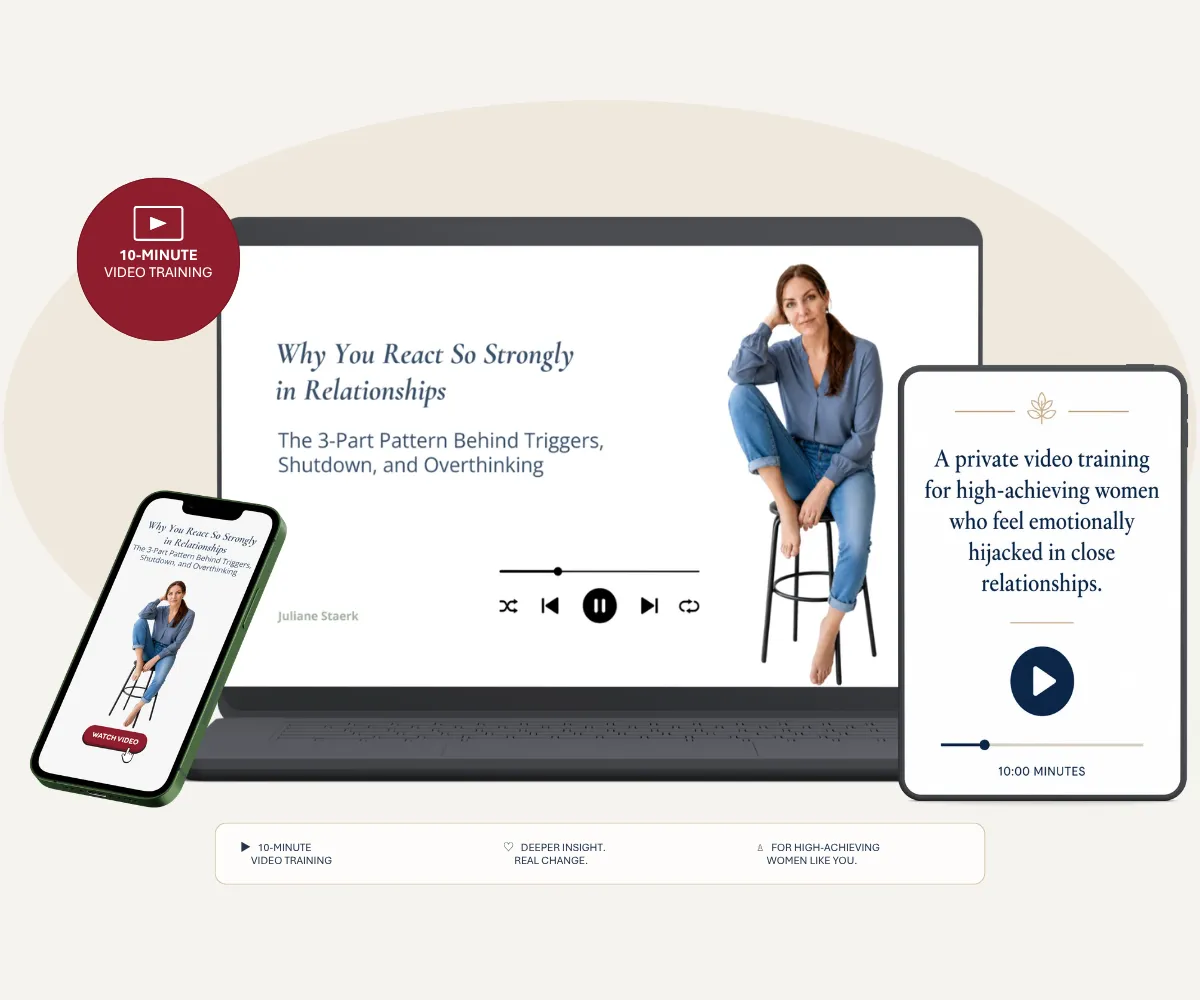
Why You React So Strongly in Relationships
Learn the 3-Part Pattern Behind Triggers, Shutdown and Overthinking
You can lead, build, decide and hold responsibility in so many areas of life.
So why can a shift in tone, a late reply, or the wrong comment still take over your whole nervous system?

You can hold a lot.
Meetings, decisions, clients and everything that comes with them. The numbers, the responsibility, the people who need something from you on any given day.
At work, in business or in leadership, you know how to function under pressure.
But then you come home.
And this should be the place where you get to land. The evening should feel quiet, the dinner should feel easy, and the conversation with your partner should feel like actual connection rather than something else you have to manage.
But then something small happens.
An unwashed cup. Socks on the floor.
A shift in his tone or a look on his face.
A moment where you suddenly feel alone with everything again.
You tell yourself not to react. You try to let it go. And then one sentence slips out anyway, and he gets defensive, and you get sharper, or you go completely quiet. The whole atmosphere changes and the evening is no longer yours.
Afterwards you replay the situation. You lose focus, you lose sleep, and you feel ashamed of yourself, not because the cup or the socks were ever the real problem, but because something in that moment touched a much bigger pattern inside you.
The fight is not the only thing it costs you
The hard part is not just what happens in the moment. It is what the moment takes from you afterwards.
It costs you energy.
The conflict may be over, but your body has not gotten the message yet. You replay what happened, turn it over and analyse every detail, and it can take hours to come back to yourself. Sometimes longer.
It costs you focus.
You are back in meetings, with clients, trying to work, but part of your mind is still in that conversation. The evening is over and yet somehow the pattern follows you into the next day anyway.
It costs you closeness.
The person you most want to feel safe with slowly becomes the person you find yourself protecting against. You withdraw, you stay busy, you create a little distance, not because you stopped caring, but because being close starts to feel like too much.
It costs you self-trust.
In the moment your reaction can feel completely justified. But afterwards you are left wondering why you keep becoming someone you do not recognise.
This is why I created this free training.
In this video training I will walk you through the three-part pattern that sits underneath the reaction.
What triggered you, how your nervous system responded, and what story your mind created in that moment.
Because once you can see those three parts separately, the reaction stops feeling like something that just happens to you.
You start to see the structure behind it, and that is where things can actually begin to change.
This is not about managing your emotions better or trying harder to stay calm.
It is about finally being able to see your own sequence clearly, so you are not spending another week recovering from a conflict that started with an unwashed cup.
What you will walk away with:
A clear understanding of why the reaction happens and why it actually makes sense once you can see the pattern underneath it.
A way to map your own trigger sequence so it stops feeling random.
This training is for you if…
You are capable, responsible and the person others rely on.
You can hold pressure in work, business or leadership, but conflict with your partner can still throw you completely off centre.
You have done some inner work already, but still get pulled into the same emotional reactions.
You can make sense of what happened afterwards, but in the moment it still feels like the reaction takes over.
You are tired of losing energy, focus and self-trust to conflicts that seem small from the outside, but feel much bigger inside.
You do not want generic relationship advice. You want to understand what is actually happening underneath your reaction.
This training is not for you if…
You are looking for quick communication tricks to make conflict disappear.
You want to focus only on what your partner is doing wrong.
You are not yet ready to look at what might be happening on your side of the pattern.

Hi, I am Juliane
On the outside, I looked driven, independent, and in control. I moved countries, earned a degree, then another, built a career, became self-employed, and kept moving forward.
But forward movement does not show what is happening underneath.
For years, I tried to understand emotional and relational patterns through the tools I trusted most: intellect, control, insight, achievement, and performance.
And still, in moments of conflict, closeness, or uncertainty, my body could move into anxiety, overwhelm, shutdown, or emotional escalation before logic had any real power to stop it.
That gap became the foundation of my work.
I am a social scientist (MA), and my work is informed by attachment dynamics, nervous system regulation, and relational pattern analysis.
Today, I help driven, self-aware women understand why they can lead, build, perform, and hold responsibility in so many areas of life, but still feel emotionally hijacked in relationships.
The spiralling. The shutting down. The overexplaining. The way one conflict can take an entire day of energy.
That is what this free training is here to help you begin to see.
Because some reactions make more sense when you understand the pattern underneath.
Ready to understand the pattern underneath your reactions?
If you are tired of losing energy, focus, sleep, or self-trust to the same emotional patterns in relationships, this free training is the place to start.